Developed by Globesight, this Country Deep Dive aims to equip policymakers, philanthropic organizations, donors and the private sector with an integrated, up-to-date situational read on Bangladesh.
Political-Economic Pulse
- Elections provide a roadmap, but stability is fragile: The decision of the Interim Government on holding the 13th parliamentary election in February 2026 has provided clarity to Bangladesh’s governance trajectory and was welcomed by domestic and international stakeholders. However, political tensions remain elevated, with the ongoing trial of former Prime Minister Sheikh Hasina and the banned political party, Awami League, sparking protests. While consensus is being reached through the National Consensus Commission on endorsing a 10-year executive term limit, divisions persist over constitutional reforms, bicameral legislature design, and electoral systems. A credible and peaceful election will be essential to restore investor confidence and anchor long-term political stability.
- Fiscal consolidation prioritizes stability over equity:. The FY25–26 national budget reflects contractionary public finance, with a 13.2% cut to the Annual Development Programme and the fiscal deficit capped at 3.62% of GDP. While aimed at stabilization, major cuts in sectoral allocations highlight underinvestment in key social sectors: health is allocated just 5.3% of the total budget, while social protection (↓16%), climate resilience (↓58%), gender equity (↓4%), and SMEs (↓24.7%) face significant reductions. This fragmented approach risks undermining pro-poor growth, resilience, and inclusive systems transformation at a time when public demand for social investment is rising.
- Investment retreat compounds social vulnerabilities: Bangladesh saw its fourth consecutive year of declining FDI inflows in 2024, falling by 13.2% to US$1.3 billion, with a net capital outflow of US$ 7 million. Weak investment is already visible in the labour market: unemployment rose to 2.7 million in early 2025, and World Bank projections suggest that an additional 3 million people may fall into extreme poverty this year, pushing the poverty rate from 7.7% to 9.3%. Persistent labor-market weaknesses and an economic slowdown underscore the urgency of restoring confidence to reverse the investment decline.
- Gains in macroeconomic stabilization remain fragile: IMF-supported reforms advanced in Q1 2025, with disbursements tied to progress on exchange-rate flexibility, tax mobilization, and banking-sector reforms. Inflation began to ease but remained high, reserves steadied between US$25–26 billion, and readymade garments (RMG) exports reached US$10.4 billion in the first quarter, cushioning external pressures. Yet these gains remain fragile: sustaining stability will depend on consistent reform implementation amid political uncertainty and external shocks, particularly from energy imports and climate disruptions.
Bangladesh’s path this year hinges on managing political stability ahead of the February 2026 elections, while sustaining IMF-anchored macro reforms. Fiscal consolidation has steadied reserves and slowed inflation, but deep budget cuts risk widening poverty and eroding social protection. Restoring investor confidence and reversing the four-year FDI decline remain critical to stabilizing growth and employment.
Priority Sectors
Agriculture & Food Security
Food inflation eased to 10.72% in January 2025, down from 13.8% in November 2024. Nearly 15.5 million people (around 16% of the analyzed population) experienced high acute food insecurity in April 2025.
Climate Change & Response
Cyclone Remal and early 2025 heatwaves displaced 3.5 million people and caused over US$2.3 billion in damages. Several government initiatives including the climate resilient EGPP and B-STRONG projects have been undertaken yet adaptation funding remains limited, with critical gaps in coastal embankments, urban drainage, and resilient energy systems.
Women & Gender Equality
Under the Interim Government, the Women Affairs Reform Commission report 2025 addressed gender-responsive budgeting, paid family leave and labor rights for marginalized women. The national budget allocated 34.11% of total budget and 4.86% of GDP towards women empowerment and development. Despite the progress being made to ensure equality, the budget is not monitored properly making it difficult to assess the impact.
Economic Opportunity & Financial Inclusion
The government is working on several initiatives, supporting SME entrepreneurs to enhance skills in technical training, and distributing US$82,000 in loans to marginal CMSME entrepreneurs, including women. Additionally, initiatives include connecting 3,000 women entrepreneurs with corporate buyers through digital platforms, updating cluster mapping, and ensuring at least 15% of loans go to women entrepreneurs.
Public Health
Child immunization coverage expanded from 2% in 1979 to 81.6% in 2025, saving 94,000 lives and preventing 5 million illnesses each year. However, about 400,000 children remain under-immunized and 70,000 have received no vaccines, with coverage in urban areas lagging behind the rural areas, highlighting the urgent need to close gaps and sustain financing.
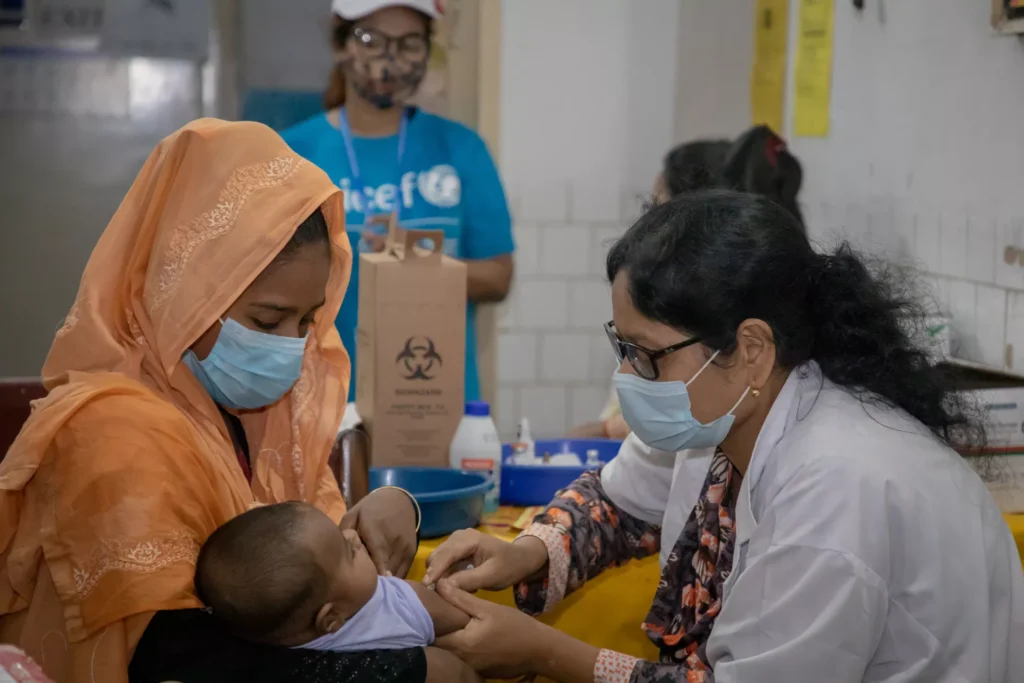
Source: UNICEF Bangladesh
In Focus
Over the past one year, Bangladesh has undertaken various initiatives for structural and institutional reforms, with a particular focus on the health sector. The Health Sector Reform Commission highlighted several challenges and opportunities addressing the infrastructural and institutional shortcomings.
Challengess
Bangladesh’s healthcare system remains severely under-resourced despite rising public demand, with the FY2024–25 allocation of US$3.8 billion – just 0.74% of GDP and 5.2% of the national budget – far below the 5% GDP and 15% budget share recommended by the Health Sector Reform Commission. Per capita health spending increased marginally to US$ ~19.8, while households continue to bear 72–74% of costs out-of-pocket, compared to a global average of 17%. Surveys show overwhelming public support for greater investment, with 92% of respondents urging higher allocations and 91% calling for primary healthcare to be a constitutional right. Yet systemic inefficiencies persist: development expenditure fell by up to 20% in FY2025–26 even as salary costs rose by 22%, leaving referral hospitals underutilized and critical shortages of doctors, nurses, and support staff undermining access and quality of care.
Opportunities
There are opportunities for creating an enhanced Digital Public Infrastructure – Health (DPI-H) ecosystem through several initiatives including the introduction of a unique health ID for every citizen, interoperable digital health records, and a robust referral system linking community clinics to tertiary hospitals. Programs related to the HPV vaccination rollout and expanding immunization emphasize the importance of digital health platforms that can track, verify, and improve service delivery at scale. Donors and private partners have opportunities to support gender-transformative health programs, youth-led digital innovation for improved health care services, and community engagement platforms.
Moving Forward
For DPI-H and health reforms to translate into real improvements in lives, Bangladesh must begin with a few strategic moves addressing the recommendations and collaborating with leading expertise. Particular focus should be on:

Way Forward
In 2025, Bangladesh is navigating a delicate balance between political transition and economic stabilization, with IMF-supported reforms helping to ease inflation and steady reserves even as foreign investment contracts and poverty levels rise. The government’s focus on fiscal consolidation has created space for macroeconomic discipline but at the cost of reduced allocations to health, social protection, and climate resilience, exposing long-standing structural gaps. At the same time, sectoral dynamics reveal both opportunities and risks: climate shocks continue to test resilience, agriculture faces mounting pressures from food inflation and soil salinity, and digital connectivity is expanding but remains uneven, especially for women. Notable advances in public health, including expanded immunization and HPV vaccination, demonstrate the potential of sustained reform and innovation, yet inclusive growth will ultimately depend on mobilizing resources and delivering on equity-focused investments that reach the most vulnerable.
Globesight will continue to closely monitor political, economic, and sectoral developments in Bangladesh, with a focus on identifying timely opportunities and risks. Our engagement will prioritize building strategic partnerships across high-impact sectors, such as public health, agriculture development, and digital inclusion to drive sustainable change and long-term impact.